I’ve got something really exciting to share with you all in this edition of the Hybrid Developer newsletter. I recently was featured in Your Property Network (YPN) Magazine in their March 2025 issue that I just had to bring to your attention.
Its about a project my team at Balada Group and I completed, showing how we transformed a single mixed-use building into multiple income-generating units using smart permitted development rights – The “Hybrid” Model.
We managed to create a flat, a commercial unit, and even a 5-bed HMO. What’s even better is how we recycled our funds for future projects. You wont want to miss this! And keep an eye out below, because I’ve also included the full interview video for you to watch.
Read the full interview below!
https://www.linkedin.com/embeds/publishingEmbed.html?articleId=7999312546692523261&li_theme=light
Background
Hardeep’s background in development is something that certainly gives him and the team a leg up, especially when it comes to these more complex developments. Hardeep says, “Prior to property development, I was a chartered QS (quantity surveyor) for about ten years working for developers working on major infrastructure projects around the UK, such as Crossrail and HS2. Those transferable skills helped me navigate towards property development and construction projects. It was a natural step for me.”

He explains that Balada Group was formed just prior to Covid after a conversation with his friends who were refinancing their home with the hope of getting into buy-to-lets. He said to them, “Look, before you do that, I think there’s something we could do with your money. I can put some money in and maybe we can do some sort of development project.” Before this, Hardeep had a few BTLs in Birmingham, but they were very much the standard BTL strategy.
They got stuck in, buying their first property together in 2019, in Acton. Hardeep says, “It was a freehold shop and upper floor. We converted the upper floor into a five-bedroom, all en-suite HMO. This was our first taste of real development.
If it ain’t broken, don’t fix it!
With Balada Group, Hardeep doubled down on this strategy. Not wanting to reinvent the wheel, they focused on executing similar developments in the same way. If they could find shops and ‘uppers’ – properties that have shops on the ground floor, and usually one or two floors above the shop – then they could rinse and repeat this model.
He explains, “2020 changed the game a bit. Boris Johnson announced a lot of PD rights changes, amalgamating a lot of the use classes within the commercial space. So, where you had doctor surgeries and shops, or newsagents or restaurants, they got amalgamated into what’s called Class E. Class E had a PD right to convert into residential under Class MA or Class G depending on which way you wanted to go. That posed a huge opportunity for us because I like to target secondary and tertiary parade shops and uppers.
What I found was you could utilise the PD rights to reduce the size of a shop and create a residential unit like a flat and an HMO above. There are a few full planning applications to do, but effectively, when I saw these shops and uppers, you buy one deal and come out with maybe four units at the back end of it. It’s almost like you’re growing a portfolio quite organically rather than having to buy four or five different properties to have the same number of units.”
The Project
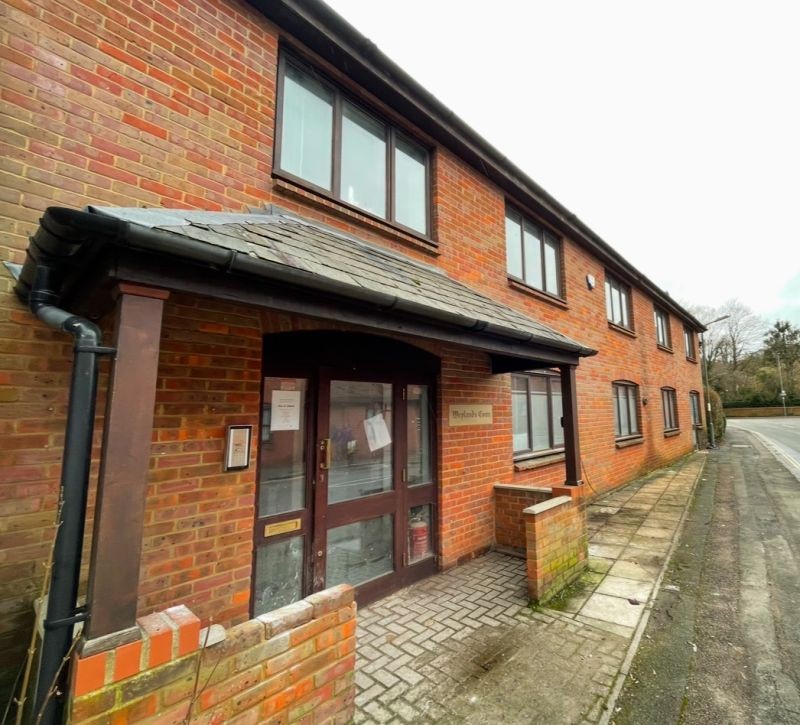
Hardeep explains that this deal started off the year before they moved on this property, by securing the next-door property, which, whilst slightly different on the ground floor, was a similar build – a shop and upper. They converted that into two ground-floor flats and an HMO above (with a loft conversion).
Whilst on site overseeing the work, the team noticed that the ground floor shop next door was often closed.
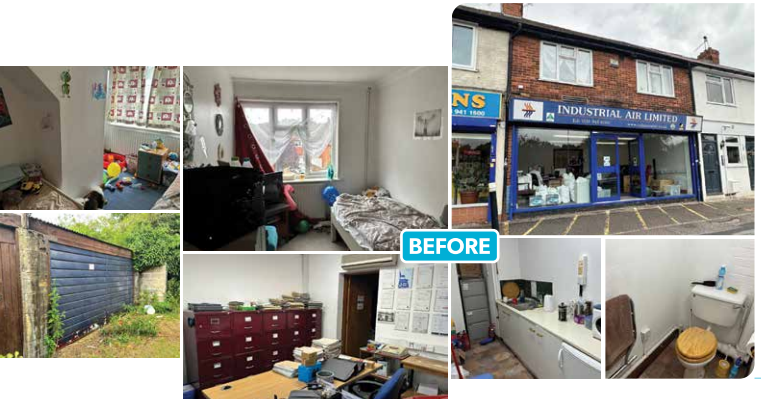
Hardeep says, “I say this to everyone – when you’re doing a project, particularly on a shop parade, especially these tertiary parades, a lot of the businesses are owner-occupied. So, if you’re looking for a direct-to-vendor purchase, let people know what you do. We happened to see that the shop next door was closed on a few occasions. I had an inkling the business may be struggling – or they were making so much money that they don’t need to open. There was something off about it.”
When the owner next door was in, the Balada team was visible. “They saw us on an ongoing basis. We built rapport with them. My business partner initiated the conversation and we just said, ‘If you’re looking to sell, just keep us in mind. We’re obviously doing next door and we’re quite happy to pay you the same sort of money we paid for that one.’ I think his business was impacted by Covid, but wider than that, he was trying to sell to retire, but part of his business was the property.
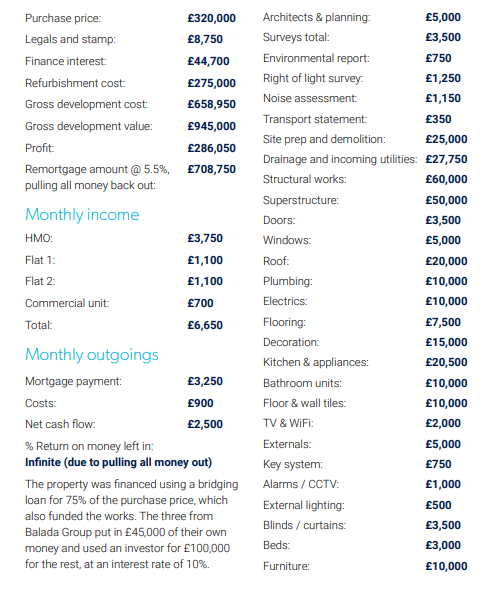
The person who wanted to buy the business didn’t want the property, they just wanted the business as a standalone. So we said, ‘Maybe there’s a win-win. We’ll buy the property, and you can sell your business separately.’ He wanted to get an appraisal to make sure we gave him market value. We bought next door for £315,000 and ended up buying this one for £320,000. Maybe we could have got it a little cheaper, but we were happy to pay that because we knew the end value quite comfortably, because we’d pretty much done everything next door”.
Key for the team was that they secured this deal before they completed next door, which allowed them to keep a pipeline of deals. Hardeep said, “That was our main thing – we’d got the next project lined up”.
The team are set on only ever buying with vacant possession, so they instructed the owner to serve notice to the tenants in the upstairs residential unit, saying they wouldn’t be able to complete without it. This is a key element of risk minimisation. If they were the ones to serve notice, it could have dragged on (which it did for the vendor) meaning they couldn’t start work when they wanted. On a costly bridging loan, it could have made a serious dent in their profits.
Whilst the sale was progressing, the team planned ahead, started the work they were able to and put in the planning applications that were necessary for the conversions with the consent of the vendor.
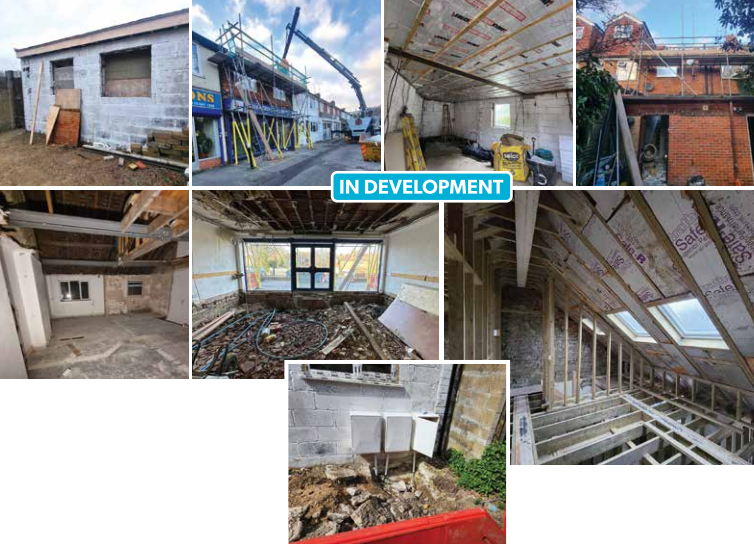
This project (which they started in early 2024 and took eight months from start to finish) was broken down into a number of different areas. The shop, which was more of an office than a shop, behind that a kitchen and then a storage area. At the back was a garage that was being used as storage (which is significant). Access to the flat above was via the rear of the property. Upstairs was a two-bedroom flat all on one floor. This was a little different to next door, which didn’t have the storage at the back but had a larger shop unit, big enough to make into two flats due to a larger rear extension.
Planning
Hardeep explains, “For C2R conversion, the minimum space requirement is 37 sqm for a studio flat. The one we did next door the year before, had about 80 sqm on the ground floor so we were able to make two residential flats.
We were looking to potentially do the same with this by converting the whole ground floor. But because there was not that rear extension on this one, the ground floor wasn’t as big. So, we basically chopped the shop up into two parts. The rear part we made into a studio flat at 40 sqm, but the remaining area to the front was only about 32 sqm. and didn’t meet the minimum 37 sqm. We thought maybe that would be great for a small barber shop or a nail bar.
We did a Class MA application, which is basically the procedure of doing the PD right because it’s a prior approval – a 56-day application for the rear into a studio flat.”
Whilst this was PD, they still had hoops to jump through, including commissioning several surveys:
- a noise assessment
- right of light survey (to ensure natural daylight covered at least 50% of the unit)
- transport statement (because the property didn’t come with allocated parking)
- contamination survey (to look at historic use of the area).
Hardeep explains that for a house, you have PD rights to convert the loft, but with a flat or maisonette, it’s different – you need full planning. “It’s a pretty straightforward application and takes about six weeks on average with most councils. We put that in simultaneously with the Class MA application downstairs.”
The secret weapon in this project was the external storage garage. If they were able to prove, via a statutory declaration from the vendor, that it was previously used as storage for the shop, then it would be classed as the same Class E shop unit, meaning they could convert it within their PD. This is key, as getting the vendor to prove previous use meant they had an additional unit to utilise, rather than just a garage.
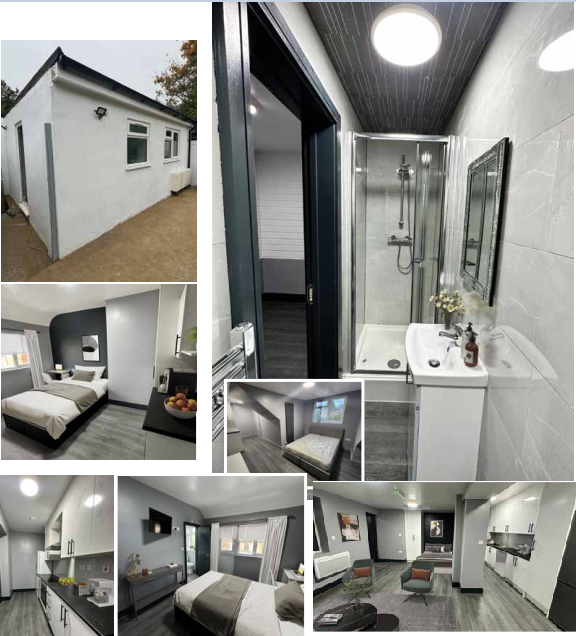
The final plan – a commercial unit, a studio flat to the rear of the commercial unit, the garage converted to a studio flat, and a five bedroom, all en-suite HMO above, utilising the loft.
Hardeep says that this sort of scenario is where a planning consultant comes into their own, helping you navigate through all the classes, and getting the most out of the space. Even though this is their bread and butter, they bring in planning consultants to make sure.
Challenges to overcome
Most projects have their challenges and as this was quite a sizeable development, there were always going to be roadblocks, learnings and mistakes.
The national minimum size for an HMO room is 6.51 sqm, but this can vary from council to council and will usually disregard any room with under 1.5m head height. With the building of the loft conversion, this council didn’t allow a full dormer due to one of their local development plans, which reduced the head height. Because they didn’t drop the joists low enough (on the floor), the head height in places was “really tight”.
The ground floor was a bit more complicated, which, given you’re going from commercial to residential, was always likely to be the case. Hardeep says, “C2R conversions under Class MA mean you can’t make any external changes. You’re only permitted to change the inside fabric of the building. And that comes with a few challenges because, if you’ve got a solid brick wall or there’s no cavity or there’s no damp-proof course, you’re having to build it retrospectively and use the space inside.
And we were getting a warranty on this. There was a lot of stuff with the warranty company saying, this needs to be done or this needs to be rectified. The number of times they said to me, just knock the wall and rebuild it. And I said, I’d love to, but I can’t”.
With external work being off the cards, all work needed to be internal. With all C2R conversions, you’re creating new homes, which means you have to meet building regs at the time of the build so this is a big thing for insulation. This meant going back to brick internally and building out from there, sorting a lot of issues along the way from earlier shoddy building. This, Hardeep explains, was costly, “I always have a contingency for any project like this, usually 10%. I don’t like to eat into all of it but on this particular one we did.” And whilst it was expensive, it future proofs the building for them to hold long term.
This was also an issue on the garage conversion, which had a single bricked wall on one side. Hardeep says, “Luckily it was about 42 sqm originally and then after we built that wall, we actually ended up with 38 sqm. So still above the 37 but we’ve had to come into the space that we’ve got. It was stressful! The number of times we went out there to use the laser and speak to the contractor saying, ‘Look, we need this space otherwise there’s no point doing all this work. If we do this and we don’t get 37 sqm we can’t make it anyway’. So yeah, that was a big challenge. Plus, during this period material prices were going up.”
The numbers